

Article Summary
The orthopedic industry just got handed a 10-year bill it can’t ignore. For decades, arthroscopic partial meniscectomy was the go-to move for degenerative knee tears: quick, billable, and surgeon-preferred.
The problem? The Finnish FIDELITY trial just published its decade-long verdict, and it’s brutal. Not only does trimming a degenerative meniscus fail to outperform a fake surgery, it actively accelerates osteoarthritis and drives patients toward total knee replacements faster.
Finland saw the data and cut procedure volumes by 90%.
The U.S.? Still doing 91,000 cases a year.
That gap between evidence and practice is where the real story lives, and it has major implications for every surgeon, hospital administrator, and device company still counting on arthroscopy volume to hold the line.
Full Article
The orthopedic industry is facing a massive wake-up call regarding one of its most reliable volume drivers. For over a decade, data has quietly chipped away at the clinical utility of arthroscopic partial meniscectomies (APM) for degenerative tears. Now, a devastating 10-year follow-up study has officially dropped a hammer on the procedure.
Writing for KFF Health News and CBS News, Dr. Elisabeth Rosenthal recently broke down a landmark study that should make every orthopedic surgeon, device manufacturer, and healthcare executive pause.
Editor’s Note: This article relies on original reporting and data compiled by Dr. Elisabeth Rosenthal. You can read her full investigative piece directly on CBS News.
The “Sham” Surgery That Exposed the Truth
Published in the New England Journal of Medicine, the 10-year results of the Finnish FIDELITY trial did more than just show that shaving a degenerative meniscus yields no benefit over physical therapy. It showed that the procedure is actively causing harm.
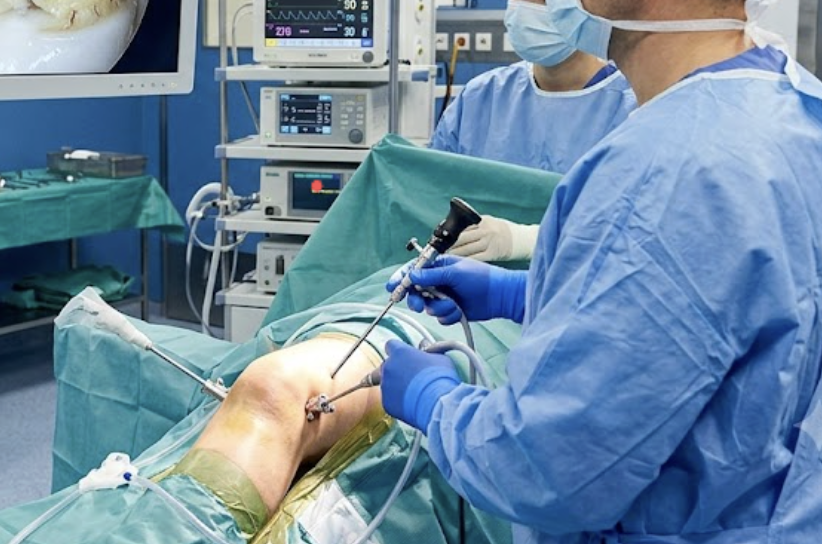
Researchers followed middle-aged and older patients who received either an actual arthroscopic cartilage trim or a “sham surgery” (a simple skin incision with no actual internal work). The decade-long data revealed a stark reality:
- No Long-Term Benefit: True surgery provided zero statistical improvement in pain or function over the fake surgery.
- Accelerated Degeneration: Patients who underwent the actual procedure suffered from accelerated osteoarthritis.
- Higher Reoperation Rates: The real-surgery cohort experienced significantly higher rates of eventual total knee replacements (TKR).
“I don’t know how I would defend this procedure at all,” remarked lead author Dr. Teppo Järvinen, head of the Finnish Centre for Evidence-Based Orthopaedics. “What has been shown dramatically is that patients who have this procedure have more pain — they do worse.”
The Macro Trend: Finland Drops 90%, the U.S. Drags Its Feet
How a market reacts to this kind of data is where the business of orthopedics gets fascinating.
In Finland, where the data originated, arthroscopic rates for degenerative tears have plummeted by 90%. In the United States, the shift is happening at a glacial pace. Traditional Medicare fee-for-service data shows volume dropped from 169,000 procedures in 2014 to 91,000 in 2024. Commercial claims data mirrors this slow bleed, decreasing by a modest 4% annually over the last decade.
Why the slow pivot in the U.S.? It’s a mix of clinical inertia, deeply entrenched regional practice patterns (the procedure remains far more common in the South than the Northeast), and financial structures.
The Regulatory & Financial Target
With Medicare paying anywhere from $2,159 to $3,875 per procedure (and commercial payers paying more than double that), a significant amount of outpatient facility fee volume relies on arthroscopy.
However, change might be forced from the top down. The article highlights growing political scrutiny surrounding how orthopedic procedures are valued. Rumors suggest that the Department of Health and Human Services (HHS), under Secretary Robert F. Kennedy Jr., is exploring ways to wrest control of physician payments away from the AMA’s Relative Value Scale Update Committee (RUC)—a panel historically dominated by specialists.
Tiger’s Takeaway: Where Does the Capital Go Now?
The writing has been on the wall for degenerative debridement, and this 10-year data likely marks the point of no return. But as one door closes, industry capital and clinical focus are already shifting:
- The Pivot to Preservation: Initiatives like the Save the Meniscus Society are championing a major paradigm shift. Instead of cutting out tissue, the industry is moving aggressively toward meniscal repair and restoration (sewing the cartilage back together). While currently optimized for younger patients with acute injuries, expect a massive wave of R&D focused on making biological repair viable for older, degenerative tissue.
- Injections and Biologics: While cortisone remains a short-term band-aid, the market for platelet-rich plasma (PRP) and stem cell therapies remains booming but controversial. Because insurance rarely covers them due to inconclusive evidence, they remain highly profitable, cash-pay alternatives for sports medicine clinics.
- TKR Acceleration: Ironically, because 10-year data shows APM accelerates the onset of severe osteoarthritis, the historical backlog of arthroscopy patients will likely continue to fuel the steady, highly profitable growth of the Total Knee Replacement and robotic joint surgery markets.
The era of “cleaning out” an aging knee is rapidly drawing to a close. The future of sports medicine belongs to the innovators who can genuinely regenerate tissue, not just resect it.
————END————